Do you remember the last time you called a customer care number and got stuck in an endless loop? "Press 1 for English... Press 2 for Billing..." It was frustrating, right?
Now, imagine doing that to your customers on your website.
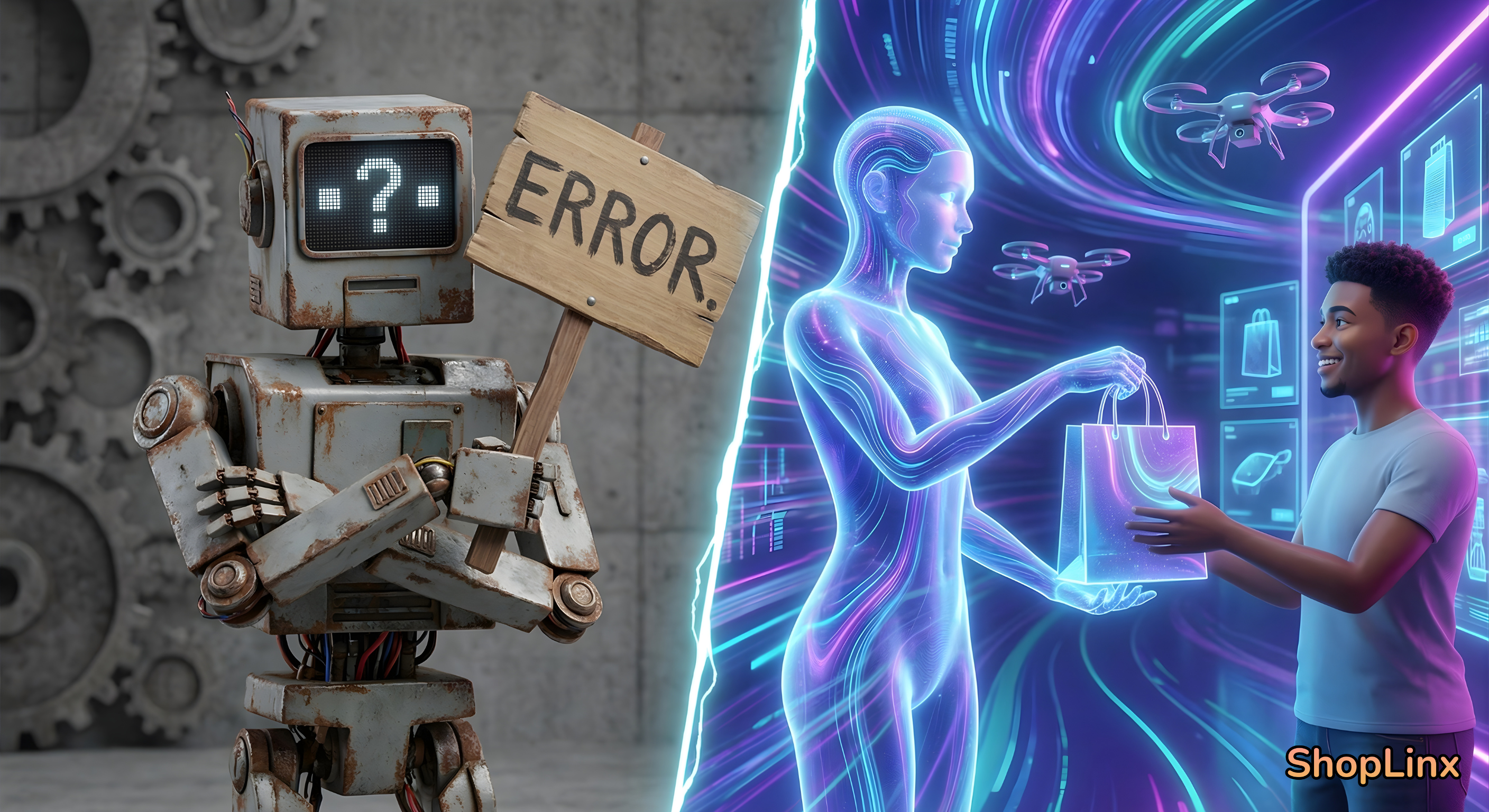
For the last decade, e-commerce brands have relied on "Traditional Chatbots" to handle customer queries. These tools promised automation, but often delivered frustration. In 2026, the game has changed entirely. We have moved from the era of to the era of
Tags
AI Chatbots vs Traditional ChatbotsRule-Based BotsAI Agents for E-CommerceShopLinx AI
"Information"
"Intelligence."
Today's shopper doesn't just want to know "Where is my order?". They expect your brand to act like a personal shopping assistant. They ask complex questions like:
"Show me a gift for my wife under ₹2000."
"Is this face wash suitable for oily skin in winter?"
A simple, rule-based chatbot will choke on these questions. It will give the dreaded reply: "Sorry, I didn't understand." And just like that, you lose a sale to a competitor who uses AI.
In this guide, we will break down the critical differences between Traditional Chatbots vs. AI Agents, and why upgrading to an AI-first platform like ShopLinx is no longer a luxury—it’s a survival necessity for D2C brands in 2026.
2. What is a "Traditional Chatbot"? (The Old School)
To understand why you need AI, you first need to understand what you are likely using right now.
Traditional Chatbots (also called Rule-Based Bots or Click-Bots) are like a train on a track. They can only go where the rails (rules) are laid down. They operate on strict "If/Then" logic:
IF customer types "Price" -> THEN show price.
IF customer clicks "Track Order" -> THEN show tracking link.
The "Parrot" Problem
Think of a traditional chatbot as a parrot. It can repeat what you teach it, but it cannot think. If a customer uses a word the bot doesn't know, the bot fails.
Example of Failure:
Customer: "Do you have this in a different shade?"
Traditional Bot: "Sorry, I don't understand 'shade'. Did you mean 'Shipping'?"❌
This creates friction. In 2026, friction is the biggest killer of conversion rates. Customers don't have the patience to guess the "right keywords" to make your bot work.
3. What is an "AI Chatbot" or "AI Agent"? (The Brain)
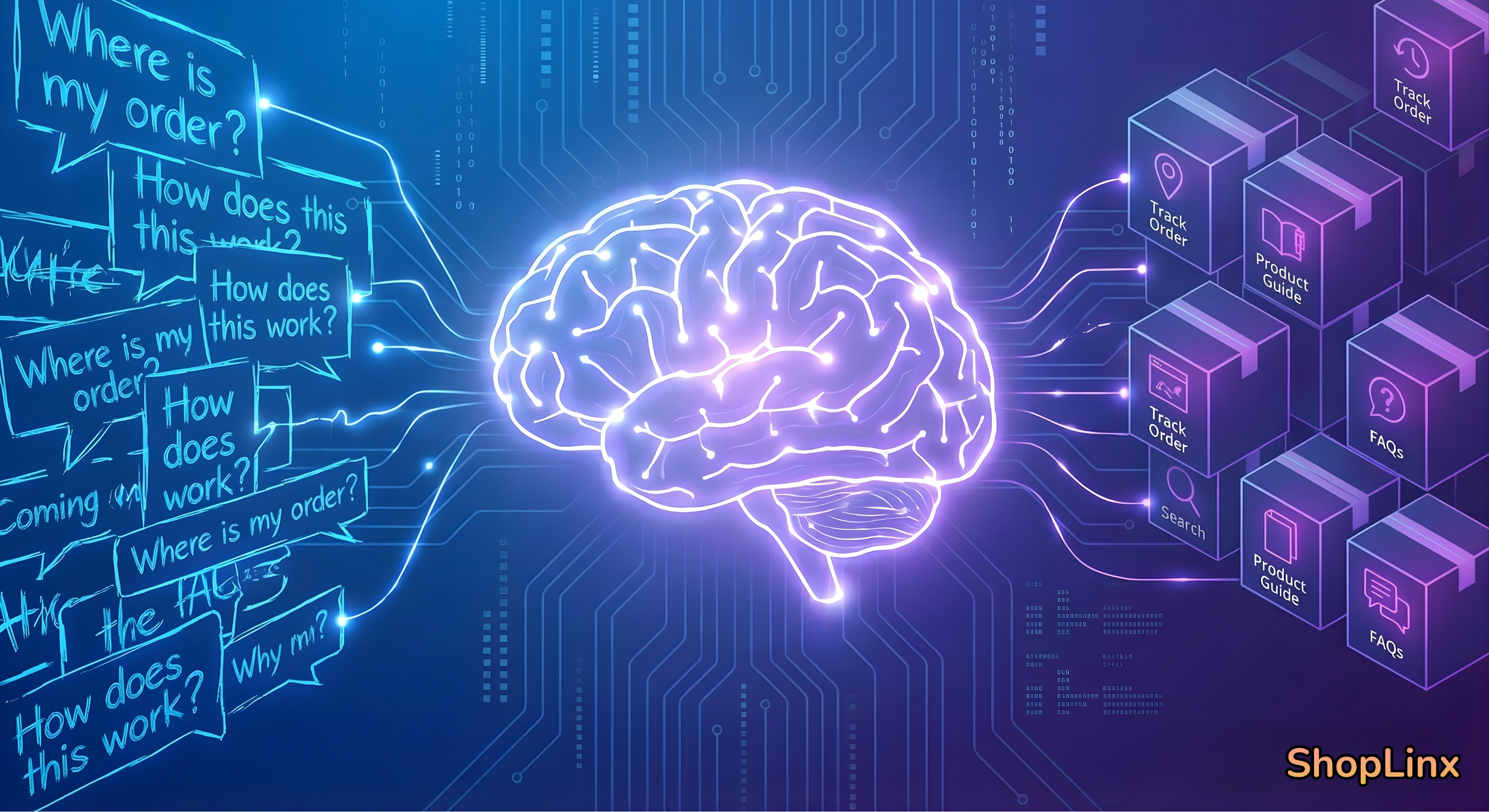
Enter the AI Agent. Unlike traditional bots that follow a script, AI Agents (powered by Large Language Models or LLMs) utilize Natural Language Processing (NLP).
Think of an AI Agent as a Top-Performing Salesman. It doesn't just "reply"; it "understands." It analyzes the context, intent, and sentiment behind the customer's message.
How It Works differently:
Instead of looking for exact keywords, it looks for Intent.
Example of Success:
Customer: "I need something for a Haldi ceremony, but not too yellow."
ShopLinx AI Agent: "I understand! Since you want something subtle for Haldi, here are our 'Mustard Gold' and 'Pastel Yellow' lehengas that are trending this season. Would you like to see the pricing?" -> Customer replies -> AI shows top 3 personalized recommendations.
Why This Matters in 2026:
Context Awareness: The AI remembers that the customer asked about "Size M" two minutes ago, so it won't ask for the size again.
Sentiment Analysis: If a customer sounds angry (e.g., "Where is my package? It's late!"), the AI detects the frustration and responds with empathy/apology instead of a robotic "Your order is in transit."
Dynamic Learning: You don't need to manually update scripts every day. The AI learns from your product descriptions and past conversations automatically.
4. Key Differences: AI Chatbots vs. Traditional Chatbots (Deep Dive)
FEATURE
TRADITIONAL CHATBOTS
AI CHATBOTS
Conversation Style
Scripted, robotic
Natural, human-like
Understanding
Limited to keywords
Understands context + intent
Personalization
Basic
Advanced, dynamic
Scalability
Needs manual updates
Learns & improves automatically
Capabilities
FAQ answering
Sales, support, recommendations
Integration
Basic
Deep integrations (Instagram, WhatsApp, Shopify)
Conversion Impact
Low to moderate
High (upsells, lead capture, follow-ups)
Let's break down exactly why switching from a "Traditional Bot" to an "AI Agent" creates such a massive difference in your business performance. It is not just about technology; it is about Customer Experience (CX).
1. Conversation Style: Scripted vs. Natural
Traditional: Feels like talking to a machine. "Press 1 for Returns." It forces the customer to adapt to the bot's language.
AI Agent: Feels like talking to a human sales assistant. It adapts to the customer's slang, Hinglish (e.g., "Bhai, delivery kab milegi?"), and tone. This builds trust instantly.
2. Understanding: Keywords vs. Context
Traditional: If a customer makes a typo ("shippng"), the bot fails. It relies strictly on exact keyword matching.
AI Agent: It understands context and intent. Even if the customer asks "Where is my stuff?" instead of "Order Tracking", the AI knows exactly what they mean and fetches the status.
3. Scalability: Manual Updates vs. Auto-Learning
Traditional: Every time you launch a new product, you have to manually update the bot's decision tree. It is a maintenance nightmare.
AI Agent: Tools like ShopLinx sync directly with your Shopify store. You add a product on Shopify, and the AI instantly knows about it. No manual coding required.
4. Capabilities: Support vs. Sales
Traditional: Great for answering FAQs (Return Policy, Email ID), but terrible at selling.
AI Agent: It is a Revenue Generator. It can cross-sell ("People who bought this Kurti also bought these earrings"), offer time-sensitive discounts, and nudge customers to complete their purchase.
5. Why 2026 is the Year of the "Omnichannel AI Agent"
In 2020, having a chatbot on your website was enough. In 2026, your customers are everywhere. They see an ad on Instagram, ask a question on WhatsApp, and check out on your Website.
Traditional Chatbots usually live only on your website's bottom-right corner. If a customer DMs you on Instagram, that bot is useless.
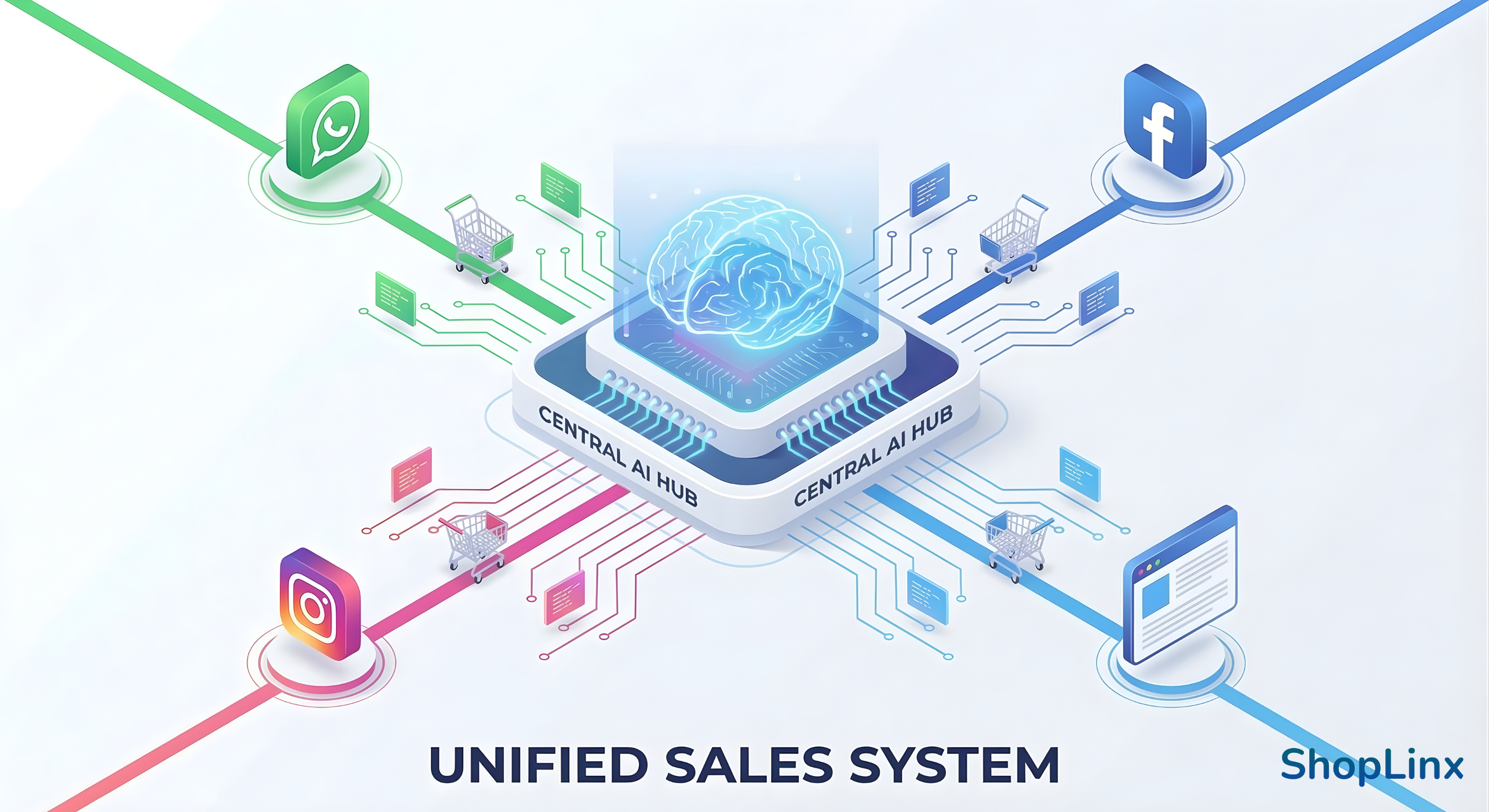
AI Agents (like ShopLinx) are Omnichannel. This means one single "Brain" manages conversations across all platforms:
Instagram Automation: It replies to DMs, Comments, and Story mentions instantly.
Website Chat: It guides visitors browsing your store.
The Impact: You don't lose context. If a customer asks about a price on Instagram and then moves to WhatsApp to buy, the AI remembers the conversation. This seamless experience is what builds 7-figure D2C brands.
6. Real-World Use Cases: How AI Wins Sales
Let's look at practical scenarios where AI beats traditional bots hands down:
Scenario A: Product Discovery (The "I don't know what I want" Customer)
Customer: "I need a gift for my sister."
Traditional Bot: "Please select a category: Men / Women / Kids." (Boring).
AI Agent: "That's sweet! Does she like traditional wear or western? Also, what's your budget?" -> Customer replies -> AI shows top 3 personalized recommendations.
Scenario B: The Out-of-Stock Heartbreak
Customer: "Is the Red Dress in Size M available?"
Traditional Bot: "Item out of stock." (End of conversation).
AI Agent: "Currently, the Red M is out of stock. But we have the same dress in 'Maroon' which is trending! Or, I can notify you on WhatsApp as soon as Red is back. What do you say?" (Saves the customer).
7. Cost Comparison: The "Expensive" Myth
One of the biggest reasons brands hesitate to switch to AI is cost. "Traditional chatbots are cheaper. Why should I pay more for AI?"
Let’s look at the math. Yes, a traditional rule-based bot might cost you less monthly (or even be free). But it has a massive Hidden Cost: Lost Revenue.
Traditional Bot: Costs ₹2,000/month. But it frustrates 50 customers, causing them to leave.
o Result: You saved money on the tool, but lost ₹50,000 in potential sales.
AI Agent (ShopLinx): Costs slightly more. But it engages those 50 customers, answers their doubts, and converts 10 of them.
o Result: You paid for the tool, but made ₹50,000 in extra revenue.
The Verdict: In 2026, don’t look at the price of the tool. Look at the ROI (Return on Investment). An AI Agent pays for itself within the first week by recovering abandoned carts and automating sales—something a "dumb bot" can never do.
8. Why ShopLinx Is the Future of AI in E-Commerce
If you are an e-commerce founder or D2C brand in India, you don't need just a chatbot; you need a Growth Engine.
ShopLinx gives you the full AI automation stack designed specifically for 2026:
WhatsApp AI Automation: Not just for support, but for marketing. Send catalogs, recover carts, and capture leads automatically.
Instagram AI: Handle DMs, Comments, and Story Mentions without lifting a finger. Turn every "PP?" comment into a DM conversation.
Hybrid Model: The AI handles 80% of the work, but allows your human team to step in for VIP customers whenever needed.
ShopLinx isn’t just another chatbot. It is your 24/7 Super Salesman that never sleeps, never asks for a holiday, and treats every customer like a VIP.
9. Conclusion: The Winner is Clear
The debate is over. Traditional chatbots served their purpose in the early days of the internet, but in the fast-paced world of 2026, they are obsolete.
Customers today demand speed, personalization, and intelligence.
Traditional Bots offer frustration.
AI Agents offer solutions and sales.
If you want to scale your business, reduce your support team's workload, and increase your conversion rate, the choice is simple. Stop using tools from 2015 to run a business in 2026.
Frequently Asked Questions (FAQ)
Here are answers to some common questions about AI Chatbots vs. Traditional Chatbots:
Q1: What is the main difference between a traditional chatbot and an AI agent like ShopLinx?
A traditional chatbot works on strict "If/Then" rules—if a customer types a specific keyword, it gives a preset reply. If the customer uses different words, it fails. An AI Agent (like ShopLinx) uses Natural Language Processing (NLP) to understand "Intent" and "Context," allowing it to handle complex queries, typos, and even Hinglish conversations naturally.
Q2: Is an AI chatbot more expensive than a traditional rule-based bot?
While the monthly subscription might be slightly higher, an AI chatbot offers a far superior ROI. Traditional bots save money on tools but lose thousands in potential revenue due to frustrated customers leaving. An AI agent actively engages users, recommends products, and recovers abandoned carts, often paying for itself within the first week of use.
Q3: Does the AI agent need manual updates every time I add new products?
No. Traditional bots require manual updates for every new item, which is a maintenance nightmare. ShopLinx’s AI syncs directly with your Shopify store. As soon as you add a product on Shopify, the AI instantly "learns" about it—including its price, description, and stock status—without any manual coding.
Q4: Can the AI handle angry or frustrated customers properly?
Yes. Unlike robotic traditional bots that repeat the same "Press 1" message, AI agents use Sentiment Analysis. If a customer sounds frustrated (e.g., "Where is my package? It's late!"), the AI detects the tone and responds with empathy and a specific solution instead of a generic robotic reply.
Ready to upgrade your store with true AI?
[Start your Free Trial with ShopLinx today] and see the difference in your first 24 hours.
Frequently Asked Questions
What is the main difference between a traditional chatbot and an AI agent like ShopLinx?
A traditional chatbot works on strict "If/Then" rules—if a customer types a specific keyword, it gives a preset reply. If the customer uses different words, it fails. An AI Agent (like ShopLinx) uses Natural Language Processing (NLP) to understand "Intent" and "Context," allowing it to handle complex queries, typos, and even Hinglish conversations naturally.
Is an AI chatbot more expensive than a traditional rule-based bot?
While the monthly subscription might be slightly higher, an AI chatbot offers a far superior ROI. Traditional bots save money on tools but lose thousands in potential revenue due to frustrated customers leaving. An AI agent actively engages users, recommends products, and recovers abandoned carts, often paying for itself within the first week of use.
Does the AI agent need manual updates every time I add new products?
No. Traditional bots require manual updates for every new item, which is a maintenance nightmare. ShopLinx’s AI syncs directly with your Shopify store. As soon as you add a product on Shopify, the AI instantly "learns" about it—including its price, description, and stock status—without any manual coding.
Can the AI handle angry or frustrated customers properly?
Yes. Unlike robotic traditional bots that repeat the same "Press 1" message, AI agents use Sentiment Analysis. If a customer sounds frustrated (e.g., "Where is my package? It's late!"), the AI detects the tone and responds with empathy and a specific solution instead of a generic robotic reply.